Posts

Trail of Tears, October 17-18, 1838

Image
Potawatomi Trail of Death - Entries from the diary of Jesse C. Douglas, Enrolling Agent under General Tipton, 17 - 18th Oct, 1838: Traveled 13 mi. to Huntsville, MO. Snow and rain. Will remain in camp for 2 days. Indians were handed straw for beds.  Painting of Potawatomi Chief Kee-O-Tuck-Kee by James O. Lewis.

Trail of Tears, October 16, 1838

Image
 Potawatomi Trail of Death - Entries from the diary of Jesse C. Douglas, Enrolling Agent under General Tipton, 16 Oct. 1838: "Traveled 18 mi. to Burkhart's Encampment. Water scarce. Health still improving."  Painting of Pottawatomie Chief Sun-A-Get by James O. Lewis

Trail of Tears, October 15, 1838

Image
  Potawatomi Trail of Death - Dairy of William Polke, 15 Oct. 1838:  “According to a promise made the chiefs a few days ago, we remained in camp. In the evening the chiefs Ash-kum, I-o-weh and others, along with a number of the Indians, assembled at Head Quarters, and shook hands for a talk. “They came, I-o-weh said, to demand the dismissal or suspension of Dr. Jerolaman, the physician for the emigration, whom they had ceased to like, and did not wish him longer to accompany the emigration. I answered and informed them that their request was one of so much importance and so unusual in emigrations, that I hoped I might be allowed time not only to decide but to counsel with my officers. The Indians then retired, with the understanding that an answer would be given them to-morrow evening. “At 8 o'clk. this morning we were on the march. The day was very windy, which rendered our passage across the prairie very disagreeable. Many of the Indians suffered a good deal. At noon we reac...

Cutting Native Hair

Image
https://indiancountrytoday.com/archive/native-history-the-astonishing-1902-order-to-cut-native-hair-AplQqjZHkUO1gmie37AeYw   Another little-known fact about how Europeans tried to suppress Native tradition. Source: Indian Country Today What was Commissioner of Indian Affairs William Atkinson Jones worried about in January of 1902? Hair, long hair on Native American men to be more precise. On January 11, 1902, he sent a letter to superintendents of federal reservations and agencies suggesting they force Native men to cut their hair by withholding rations and employment. “The wearing of long hair by the male population of your agency is not in keeping with the advancement they are making, or will soon be expected to make, in civilization,” Jones says in the order. “The wearing of short hair by the males will be a great step in advance and will certainly hasten their progress towards civilization.” The letter talks about eradicating traditional habits at boarding schools,...

Trail of Tears, October 12 & 13, 1838

Image
 Potawatomi Trail of Death – Diary of William Polke, Oct. 13, 1838: "This morning as we were on the eve of leaving our encampment, a number of the Indians headed by the chief Ash-kum came up to Head Quarters, and requested an interview with the Conductor and Gen. Morgan. Ash-kum arose and in a short talk informed the Conductor that the Indians were unwilling that Gen. Morgan whom they had been taught to recognize as principal in the emigration, should leave them. They felt, he continued, that Gen. M. was near to them as a protector—he had made them pledges upon which they depended, and the fulfilment of which induced them in part to consent to their emigration.” “The Indians also requested thro' Ash-kum liberty to travel less and remain longer in camp. Judge Polke answered. He informed them that Gen. Morgan had voluntarily offered his resignation, and that he had been appointed to conduct them to their new homes, with the consent of Gen. M. etc. etc. Gen. Morgan also responded...

Trail of Tears, October 11, 1838

Image
Potawatomi Trail of Death - Entry from the diary of Jesse C. Douglas, Enrolling Agent under General Tipton, 11 Oct. 1838: "Traveled 13 mi. to Pleasant Spring near Palmyra, Mo. A woman died." Note: Nishnabe Gishek wabek (The People’s Day tomorrow - or Natives Day - or First people’s...) 

Trail of Tears, October 10, 1838

Image
Potawatomi Trail of Death - Diary of William Polke, 10 Oct.1838: “The settlement of yesterday was concluded today, and every person engaged in the service, save the officers of the emigration, was paid up to the thirtieth. In order to allow the wagoners an opportunity of repairing their wagons, shoeing their horses and making other repairs necessary for the safe prosecution of the journey, much extra ferriage was done during the two days of our encampment at the river. “This might have been avoided by remaining on the Quincy shore, but the dissolute habits of the Indians and their great proneness to intoxication, forbid such a step on the part of the agents of the  government. At sunset all the wagons that had been repairing, were in camp, and we were prepared for next day’s journey.”                  NOTE: Roots of the epidemic of alcohol-related problems among Native Americans is a direct response to European arrival. Evidence from his...

Indigenous Peoples Day, October 12 (Not-Columbus-day)

Image
 Sorry I don’t know the artist to give attribution to 

Trail of Tears October 9-10, 1838

Image
 Potawatomi Trail of Death - Entries from the diary of Jesse C. Douglas, Enrolling Agent under General Tipton, 9 - 10 Oct. 1838.  "Quincy, Illinois. Continue to steam ferry across river to enter Missouri.  3 children died."

Trail of Tears, October 8, 1838

Image
 Potawatomi Trail of Death - Diary of William Polke, 8 Oct. 1838 “In order to reach Quincy and forward the ferriage of the river as much as possible, parties of the emigration were detached and sent a-head at seven o’clock. At 10, a great portion of the emigrants had reached the river, seven miles from the camp of last night. A steam ferry-boat which had been previously employed was in waiting for, and the Indians were immediately put on board.” “By night we succeeded in crossing all the Indians, horses, and several wagons. The remainder will be brought over as early as convenient, tomorrow. It is with the utmost difficulty that many of the Indians are restrained from intoxication. A guard has to be kept under arms in every town through which we pass. Tomorrow will be employed in the payment of the officers and troops. Three children died since morning.” Potawatomi's at the Wabash by George Winter.

Trail of Tears, October 6 & 7, 1838

Image
Potawatomi Trail of Death - Entries from the diary of Jesse C. Douglas, Enrolling Agent under General Tipton, 7 Oct. 1838: "Traveled 12 mi. to Mill Creek in Illinois. Preparing to ferry across river to Missouri. A child died.”  "Eight Potawatomi Women" by George Winter. Potawatomi Trail of Death - Diary of William Polke, 6 Oct.1838: “At a little before eight in the morning we left the encampment of last night. During the night we were visited by a fall of rain which rendered the travelling today unusually pleasant. The dust has been completely allayed, and the air much cooled. Water on the route was only to be found in stagnant ponds. “At three o’clock we reached our present encampment, which from the barrenness of the spot in everything save grass, brush and weeds, we have appropriately named Hobson’s Choice. “Beef and potatoes were issued to the Indians this evening. Forage, corn and hay. A child died since we came into camp. Distance travelled today eighteen miles.”  ...

Trail of Tears, October 5, 1838

Image
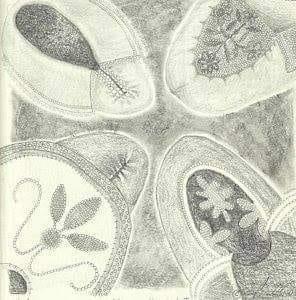
 Potawatomi Trail of Death - diary of Jesse C. Douglas, Enrolling Agent under General Tipton, 5 Oct. 1838 Traveled 12 mi. to McKee's Creek. Subsistence: beef & flour. Had to hunt for water, found only in stagnant ponds.  Drawing titled "Mikesen" (shoe) by Candi Wesaw.

Trail of Tears, October 4, 1838

Image
 Potawatomi Trail of Death - Diary of William Polke, 4 Oct.1838:  "Although the ferriage of the river was completed last night before we slept, it was thought advisable by the Conductor to remain in camp today. The Indians made use of the opportunity thus afforded, to furnish themselves with moccasins, continue to wash their blankets and clothes, and do many other thing necessary to their comfort and cleanliness during the remainder of the journey."  "The health of the Indians is now almost as good as before we commenced our march from Twin Lakes - a few days more will entirely recruit them. A young child died in the evening."  (NOTE: They spent 9 hours fording Illinois River. It is believed that Phillips' Ferry from Valley City, a few miles south of Naples, was hired to do the ferrying.).  Drawing "Abakweshk Naken" meaning Cattail Mat by Candi Wesaw.

Trail of Tears, October 3, 1838

Image
 Potawatomi Trail of Death - Diary of William Polke, 3 Oct. 1838: “Left Exeter encampment at a little before eight o’clock, and without any occurrence of note reached the Illinois River at about 11 a.m. – nine miles distant from last night’s camp. Preparations were made for ferrying the river, and we embarked in keel and flat boats directly after our arrival.” “The day was spent in crossing and re-crossing the stream, and by nine p.m. we succeeded in landing the last of the baggage wagons. We are now encamped on the opposite shore from Naples, where we shall perhaps remain to-morrow, to recruit the fatigues of the last few days. Able to wash clothese & make mocasins. 2 children died directly after our arrival at the river.”  Drawing by Candi Wesaw.

October 2, 1838

Image
 Potawatomi Trail of Death - Diary of William Polke, 2 Oct. 1838: “We struck our tents at 8 this morning, and prepared for a march. Owing to the very great curiosity manifested by the citizens generally, Judge Polke, after being solicited, marched the emigration into the square, where we remained for fifteen or twenty minutes.” “Presents of tobacco and pipes in abundance were made by the citizens to the Indians, who appeared quite as much delighted with the favor shown them as with the excellent music of the band which escorted us around the square. We continued our journey, and at three o’clock reached our present encampment about sixteen miles from Jacksonville.” “The day was excessively warm and the dust very afflicting, added to which water was scarcely to be found on the route. Provisions and forage we find in considerable quantities, without difficulty." Picture of Abram Burnett, member of the Trail of Death.

Trail of tears, October 1, 1838

Image
 Potawatomi Trail of Death - Diary of William Polke, 1 Oct. 1838: “Early in the morning we left Island Grove—travelled over a dry prairie country, seventeen miles, we reached our encampment, near Jacksonville, at 3 o’clock in the afternoon. Nothing occurred during our march save that a child fell from a wagon, and was very much crushed by the wheels running over it. It is thought the child will die.” “Tonight some of the chiefs reported two runaways, who left this morning. During the evening we were much perplexed by the curiosity of visitors, to many of whom the sight of an emigration or body of Indians is as great a rarity as a travelling caravan of wild animals. Late at night the camp was complimented by a serenade from the Jacksonville Band." Painting of "Pe-che-co, a Pottowattomie Chief" by James Otto Lewis.

Trail of Tears, September 30, 1838

Image
Potawatomi Trail of Death - Entries from the diary of Jesse C. Douglas, Enrolling Agent under General Tipton, 30 Sept., 1838: Traveled 6 mi. to Island Grove. A child died. A dragoon (soldier) dismissed for intoxication. Painting of Na-ma-nis-cut, a Potawatomi Chief by James Otto Lewis

September 28 & 29, 1838

Image
Potawatomi Trail of Death - Diary of William Polke, 29 Sept. 1838 “In order to pass Springfield at as early an hour as possible, we rose before light, and at 8 o’clock were on our way. The Indians amongst whom a degree of pride was excited, arranged themselves into line, and with an unusual display of finery and gaudy trumpery marched through the streets of Springfield.” “The wayfares were covered with anxious spectators, so much so indeed as to threaten for a time to impede the progress of the Emigration. We passed clearly through however, and that too without the detention of a single Indian.” “At 3 we reached our present encampment, McCoy’s Mills, distant from last night’s camp - seventeen miles. This morning, Dr. Jerolaman on account of his continued indisposition, requested leave to remain in Springfield a few days to recruit. Permission was granted. Our march today was through a very dry region of country. We are now encamped on a stream affording little water.”  Pictures dep...

Trail of Tears, September 26 & 27, 1838

Image
 Potawatomi Trail of Death - Diary of Jesse C. Douglas, Enrolling Agent under General Tipton,  27 Sept.1838:  "Traveled 14 mi to, Long Point, Ill.  Indian men procuring so much game that rations not needed, camp is full of venison." Journal entry of Father Benjamin M. Petit; Sept. 27, 1838:   “I have for two successive days the happiness of celebrating Holy Mass among my good savage children. I administered to several who were dying and baptized a few more infants. We will leave six graves in the shadow of the cross when we quit this camp.” “We find ourselves on the grand prairies of Illinois under a burning sun and without shade from one camp to another. They are as vast as the ocean and the eye seeks in vain for a tree. Not a drop of water can be found – it is a veritable torture for our poor sick, some of whom die each day from weakness and fatigue.”   Drawing of Nene Ngot by Candi Wesaw. Potawatomi Trail of Death - Diary of William Polke, 26 Sept. 1838:...